
How We Know What We Know About July 8, 1776 in Easton, Pennsylvania
The archives kept everything but the name. A family scrapbook kept the name: Robert Levers. On this Heritage Day, Easton’s founding story is a lesson in how history actually gets made.

Two hundred and fifty years ago this week, someone stood up in the center of Easton and read the Declaration of Independence out loud.
We know this happened. If you’re from Easton, you’ve grown up always knowing this piece of history. But this year, on the 250th anniversary of the reading of the Declaration, something interesting happened — some people started asking a question that, as far as I can tell, almost nobody in Easton had thought to ask before:
How do we know it was Robert Levers?
I want to sit with that question for a minute, because I think it may be more of a gift than it sounded when I first heard it asked.
What we actually know for certain
On Thursday, July 11, 1776, the Pennsylvania Evening Post in Philadelphia printed a dispatch from our town. “EASTON (Northampton county) July 8,” it begins. “This day the DECLARATION of INDEPENDANCY was received here, and proclaimed.” The account describes the field officers of the first battalion gathering at the courthouse, the light infantry marching in with drums beating and fifes playing, and a standard displayed whose device, the dispatch says, was “the thirteen United Colonies.” And then: the Declaration “was read aloud to a great number of spectators,” who answered with three loud huzzas and a cry of “MAY GOD LONG PRESERVE and UNITE the FREE and INDEPENDANT STATES of AMERICA.”
Yesterday, as I was scrolling through my Facebook feed, I saw a post from the Easton Area Public Library. It was images, from their Marx Room collection of historic documents, of that very newspaper page. It is a strange and wonderful thing to read a firsthand account of the moment your hometown celebrates every summer — printed three days after it happened, in ink that has long outlived everyone who heard those huzzahs.
Here is what that account does not contain: a name. Drums, fifes, the flag, the crowd, the exact words they shouted back — and not one mention of the name of the person who did the reading.
A question nobody thought to ask
If you were a kid who grew up in Easton, you were taught that Robert Levers read the Declaration of Independence in our very own city on that day. You probably learned it in elementary school. It was part of our local history, like learning that Larry Holmes was the World Heavyweight Champion. It’s why we celebrate Heritage Day with fireworks instead of having them on the Fourth of July. It’s painted into a 1960 mural that hangs in the county courthouse, showing Levers mid-reading surrounded by a cheering crowd.
But earlier this year, the Sigal Museum’s “Read This!” exhibit on the history of local media did what good museums do: it looked hard at the actual written, published record. Tim Betz, the curator behind the exhibit, pointed out that there’s an “astonishing vacuum” of detail around the reading. His observations aren’t limited to what other people didn’t write. His sharpest one is about what Levers himself didn’t. In all of the documents written in Levers’s own hand that Betz has examined — and Levers wrote often, and in detail, about his own part in events — he never once mentions the moment. Not as the reader. Not even as someone standing in the crowd. Betz also notes that the public didn’t start crediting Levers with the reading until surprisingly recently — perhaps not until the mid-1900s.
I’ll be honest: I was pretty shocked when I heard this. You don’t love hearing that a story your town has taken pride in for generations can’t actually be backed up with a paper trail.
My second reaction was to go to my Ancestry.com account and start digging. That quickly led to a free trial of Newspapers.com, and one thing led to another. I may have lost more than a few hours this week.
What the paper trail shows
Here’s what the paper trail actually shows, and I think it’s better than the story we all grew up with.
No document puts the Declaration in Robert Levers’s hand on July 8, 1776. But the documents put him everywhere around it.
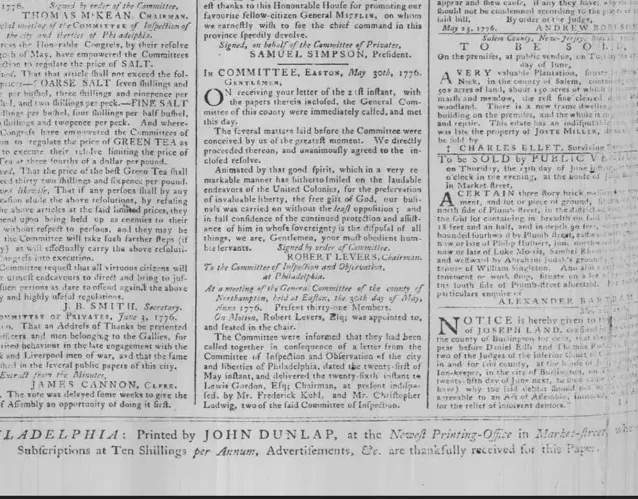
On May 30, 1776 — five weeks before the reading — Northampton County’s revolutionary committee met at Easton with Robert Levers presiding, and when the thirty-one members named their six delegates to the Provincial Conference in Philadelphia, the meeting that would push Pennsylvania toward independence, Levers’s name was listed first. Both the Pennsylvania Gazette and the Pennsylvania Packet printed the proceedings within the week — the Packet off the press of John Dunlap, the same printer who, weeks later, would print the official copies of the Declaration that went out to towns like ours for exactly the kind of public reading we celebrate. In other words, in the very weeks the Declaration was being written, debated, and printed, Robert Levers was Northampton County’s official channel to Philadelphia. If a copy of that document traveled up to Easton, Levers would have been the obvious channel.
And the following spring, the new state government gave him a job that tells you exactly what kind of man his contemporaries thought he was: in March 1777, they made him prothonotary — the keeper of the county’s official papers and records. The commission, signed in Philadelphia that March, commits “the papers and Records of the said County . . . to your Care and Defence.” Care and defence. When Pennsylvania needed someone in Easton it could trust with documents, it picked Levers.
So here’s where the record actually leaves us: the oral tradition says Levers read it. The documentary record says if anyone in Easton read it, Levers is overwhelmingly the man. Those are not the same statement. But here’s what the question actually did — at least in my case. It didn’t tear anything down. It sent me to the archives, and the archives sent back a Robert Levers who is more interesting, more documented, and more central (not just to that week, but to the whole season leading up to it) than the mural version ever was.
The scrapbook
There’s one more kind of archive I want to tell you about, and it doesn’t live in a library.
This is where Bill Levers comes in. Bill is a descendant of Robert Levers, and we grew up together in Easton — we’ve known each other for about 40 years. So after my week down the research rabbit hole, when I’d decided I wanted to write about this, I messaged Bill to ask if he had any photos of readings past. Bill went to his archives: the family scrapbook. And out of it came a Morning Call clipping from July 1981. At Easton’s fifth Heritage Day — 205 years to the day, the article notes — the Declaration was read by John Levers, a descendant of Robert, his son standing beside him holding a flag. Alongside the clipping: a thank-you letter to the family from Evelyn Gulick and the Downtown Improvement Group, on its 1981 stationery.

Think about what that scrapbook is. Nobody catalogued it. No institution preserved it. A family simply decided, generation after generation, that this story was theirs to keep — and kept it. When historians talk about oral tradition, this is what they mean: not rumor, but stewardship. The Levers family has been maintaining their end of Easton’s memory one generation at a time, in shoeboxes and scrapbooks, and this week a page of it surfaced exactly when the town’s story needed it.

That’s how history happens. Not in one place, or at one time. A newspaper printer in Philadelphia saves the event. A family saves the name. A museum curator, 250 years later, asks the question that sends everyone back to check. A library posts a photograph of that 1776 page, and a few thousand people scroll past the actual first draft of our founding story between a lost-dog notice and a road-closure alert. Every one of those hands is doing history. Including, if you’ve read this far, yours.
This morning, at Heritage Day, Christopher Black stood in Centre Square surrounded by reenactors and read the Declaration of Independence, the way someone did on July 8, 1776 — two hundred and fifty years, almost to the day, after the first time.
And in that crowd this morning, watching, was Bill Levers. The 1776 dispatch never tells us who did the reading or whether a Levers stood among the spectators that day. This time, I can tell you a Levers was there. There are photos to prove it.
Was that first someone Robert Levers?
Here’s my answer, offered with full disclosure that I’m an Easton kid who grew up on this story and a 40-year friend of the family who kept it: I believe it was. Not because the tradition says so, but because I’ve now read the documents, and the documents keep pointing at the same restless, ambitious, paper-obsessed man standing at the exact intersection of Philadelphia and Easton in the summer of 1776.
But I’ll tell you what I believe even more. A town that can hold both things at once — the certainty of its celebration and the honesty of its questions — is doing something harder and better than remembering. It’s keeping history alive, which was always a group project anyway.

Laini Abraham is the founder and publisher of Easton Post. She and Bill Levers, a descendant of Robert Levers, have known each other since eighth grade at Shawnee Intermediate School. Bill has written about the family’s Heritage Day history for Beard Bros, the cannabis media company he co-founded.

Get Easton Post in your inbox.
Subscribe to our mailing list to get Laini’s List weekend guides and more.
Free · One email a week · Unsubscribe anytime


